
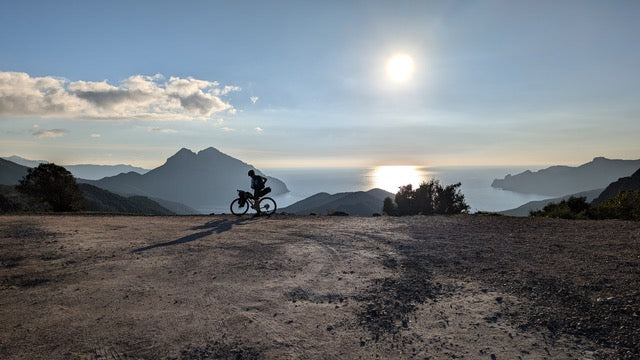
Saturday, November 9, Latte di Ventimiglia, 6:00 p.m.: we turn on the lights, since by now it is dark. Thus begins our journey. Destination Nice, where a ferry to Corsica awaits us.
It might seem strange to most people to begin a bicycle journey on a late November afternoon, well after sunset. But that is how it is. Every hour, every minute must be seized from work, from family, from the commitments of daily life.
Why that destination, I do not know. Perhaps in our minds that island in the month of November represented a small corner of wild land, abandoned by noisy tourists.
Or perhaps, in the end, all that mattered was setting off, traveling.

We fasten our two bicycles securely to a large stanchion in the belly of the ship, since, after all, they are all we have and the most important thing for the success of the journey. It is they who will carry us on this adventure, and it is they who will bear those few and essential bags that we bring with us. Luggage: a keyword for those who travel by bicycle. When you travel by bike you must be light in body and mind. You must leave at home as much as possible, objects and thoughts alike, intent only on solving the problems of the here and now, focused on your immediate survival.
For an entire week, Corsica revealed itself in all its wild beauty, far OLTRE our best expectations. Nature tempered us, healed us, and enchanted us. But it also put us and our vehicles to the test with its unpaved roads, its impenetrable scrubland, the pastures to cross, the deep fords, the insurmountable mud and sand, and the biting cold of its mountains.
I could go on at length recounting one stage or another, that dizzying mountain pass or that stretch of coast at sunset. But these are things you already know. Instead, I would like to use these few lines to shed light on the bicycle itself. What we do not know, or perhaps pretend not to know, is that the speed of a bicycle is the thing most in sync with the concept of travel. Traveling by bicycle has nothing to do with all the other "forms of pedaling." It certainly has nothing to do with the world of competitions and competitive racing.
It is simply the best way to come to know oneself and the environment that surrounds us. It is the essence of travel. Its steady pace, its slow gait, set within the rhythm of the day governed by the sun, essential with its light and its warmth for pedaling well, are the thing most suited to human life and well-being. Our bodies and our minds in such a condition had far more vigor to overcome any obstacle, and for this reason, every time a fork in the road appeared, we always enthusiastically opted for the more adventurous, more rugged, more gravel road.
The bike — in my case a Bianchi Arcadex dressed in its classic celeste, somewhat like little Momo in Ende's novel — taught us to reclaim all the time that has been stolen from us by the frenzy of everyday life, and to devote it to ourselves and to our own experience.
Two friends, two bicycles and two tents: before us the deserted roads of Corsica. Days that will remain imprinted in my mind forever.
Diego Novara